Auto
9 Classic Cars That Make Exceptional Daily Drivers
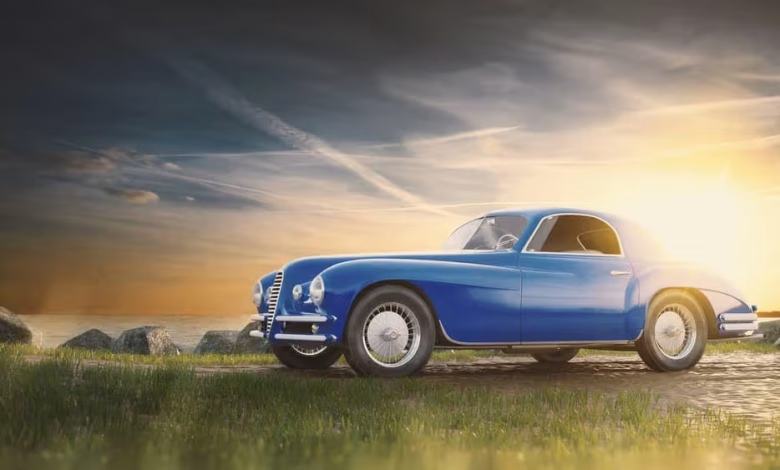
The modern showroom is dominated by homogenized crossovers, numb electronic steering racks, and intrusive digital touchscreens that require three submenus just to adjust the cabin temperature. For drivers who crave mechanical feedback, tactile switchgear, and genuine character, the appeal of commuting in a vintage automobile is undeniable. Yet the romantic notion of driving a classic every day often collides with harsh mechanical realities. Vapor lock on humid summer afternoons, finicky dual carburetors that refuse to idle in November chill, and nonexistent replacement parts can turn an ambitious dream into an expensive driveway ornament.
A true daily driver must satisfy uncompromising criteria: it must start on the first crank, stop confidently in stop-and-go highway traffic, resist overheating during gridlock, and offer readily available mechanical spares. Fortunately, an elite tier of vintage machines was engineered with such exceptional durability and ergonomic foresight that they can still conquer the modern nine-to-five grind. These nine classic cars deliver authentic vintage soul without demanding a support vehicle following in your wake.
What Separates a Usable Classic from a Weekend Project?
Before selecting an older vehicle for daily transportation, it is essential to understand the functional divide between a show car and a commuter. An automobile tasked with weekday duty cannot rely on delicate mechanical systems or unobtainable trim pieces.
To thrive in modern traffic conditions, a classic car requires four foundational attributes:
-
Electronic Fuel Injection or Dependable Mechanical Fuel Delivery: While carburetors have their charms, early electronic fuel injection systems like Bosch Motronic or robust Bosch K-Jetronic eliminate the morning cold-start rituals and altitude sensitivities that plague older setups.
-
Competent Braking Systems: Merging into contemporary highway flow means sharing the road with modern vehicles that can stop from sixty miles per hour in a fraction of the distance required by vintage drum brakes. Front disc brakes are a non-negotiable minimum for commuter safety.
-
Active Parts Supply Chains: A broken water pump or snapped throttle cable should sideline your commute for twenty-four hours, not six months spent hunting European salvage yards.
-
Adequate Thermal Management: The cooling system must handle prolonged idling with the air conditioning running on asphalt radiating afternoon heat.
When these engineering baselines are met, an older car ceases to be an anxiety-inducing gamble and becomes an engaging, reliable companion on the open road.
The Indestructible European Workhorses
During the late 1970s and 1980s, European automotive engineering was largely dictated by bench-tested durability rather than planned obsolescence. Several models produced in this era set benchmarks for longevity that have never been surpassed.
1. Mercedes-Benz W123 (1976–1985)
Few automobiles in history command the universal respect earned by the Mercedes-Benz W123 chassis. Engineered during an era when Stuttgart’s engineering department operated with virtually unlimited development budgets, the W123 was designed to serve as taxi fleets across Germany, North Africa, and the Middle East under the most punishing conditions imaginable.
Whether equipped with the naturally aspirated OM617 diesel engine or the lively M102 four-cylinder gasoline powerplant, these cars are fundamentally overbuilt. The doors close with the vault-like thud of solid steel, the interior MB-Tex synthetic upholstery outlasts genuine leather by decades, and the independent suspension delivers a supple, composed ride that glides over broken city pavement. With four-wheel disc brakes as standard equipment and a global network of reproduction and original equipment parts, a well-sorted 300D or 280E handles modern highway speeds with relaxed confidence.
2. Volvo 240 (1974–1993)
Affectionately nicknamed the Swedish brick, the Volvo 240 is perhaps the most pragmatic vintage commuter ever built. Produced largely unchanged for nearly two decades, the 240 was designed around brutal Scandinavian winters and demanding safety standards that were decades ahead of their time.
The secret to its daily usability lies beneath the hood: the legendary B21 and B230 “Redblock” engines. These cast-iron, non-interference overhead-cam four-cylinders are renowned for reaching five hundred thousand miles with little more than routine fluid changes and timely timing belt replacements. Thin roof pillars provide phenomenal outward visibility, creating a panoramic greenhouse that modern cars with their massive blind spots cannot match. Combined with robust four-wheel power disc brakes, an exceptionally tight turning radius, and an enormous rear cargo area, the 240 remains the ultimate anti-status daily driver.
3. BMW 3 Series – E30 Generation (1982–1994)
The second-generation BMW 3 Series defined the modern compact executive sports sedan, balancing everyday functionality with razor-sharp handling. While pristine M3 models have escalated into speculative investment territory, the standard six-cylinder 325i and four-cylinder 318i remain remarkably practical road cars.
The E30 features communicative rack-and-pinion steering, a perfectly balanced chassis, and supportive, driver-focused interior ergonomics. Thanks to Bosch Motronic fuel injection, cold starts are crisp and immediate. The car is small enough to dart through heavy city traffic and squeeze into tight curbside parking spots, yet comfortable enough for extended interstate cruising. Crucially, the enthusiast community for the E30 is among the largest in the world, ensuring that everything from suspension bushings to cooling components can be ordered online for next-day delivery.
Domestic Icons with Unmatched Parts Availability
American classics offer an entirely different advantage for the daily commuter: mechanical simplicity and total parts accessibility. Any neighborhood auto parts store between Maine and California will likely have replacement hardware in stock on a Tuesday afternoon.
4. Chevrolet C10 Squarebody (1973–1987)
If your daily routine demands cargo hauling, yard work, or all-weather versatility, third-generation Chevrolet C/K pickups—commonly known as Squarebodies—offer unmatched practical appeal. Their utilitarian proportions, upright cabs, and clean lines have aged into genuine Americana cool.
Underneath the hood sits the mechanical cornerstone of American motoring: the Small Block Chevy V8 or the durable 250 cubic-inch inline-six. These engines are so mechanically straightforward that routine tune-ups require only basic hand tools. Replacement carburetors, alternators, water pumps, and brake calipers cost a fraction of modern components and can be swapped out in a home driveway within an hour. Equipped with factory front disc brakes, power steering, and optional air conditioning, a properly maintained Squarebody handles suburban errand running and daily commuting with effortless charm.
5. Jeep Cherokee XJ (1984–2001)
The Jeep Cherokee XJ essentially invented the modern unibody sport utility vehicle, striking an ideal compromise between rugged off-road capability and manageable exterior dimensions. Unlike truck-based body-on-frame SUVs of its era, the XJ is lightweight, nimble, and easy to park.
The primary reason to daily drive an XJ is the AMC-designed 4.0-liter inline-six engine, particularly those produced from 1987 onward with electronic multi-port fuel injection. This engine produces thick low-end torque, runs smoothly, and routinely shrugs off astronomical mileage figures. Paired with the bulletproof Aisin-Warner AW4 automatic transmission and a rugged solid-axle suspension, the Cherokee shrugs off winter blizzards, deep potholes, and unpaved roads while offering honest five-passenger utility and fold-flat cargo capacity.
Pure Sports Cars You Can Actually Live With
Most classic sports cars demand compromises that quickly sour their appeal during an early-morning commute: claustrophobic cabins, unpredictable electrics, and clutches heavy enough to induce knee pain in traffic. However, two sports cars cracked the code of daily livability.
6. Mazda MX-5 Miata – NA Generation (1989–1997)
When Mazda unveiled the first-generation Miata with its iconic pop-up headlights, their objective was explicit: capture the sensory magic of a 1960s British roadster while eliminating the oil leaks, Lucas electrical gremlins, and mechanical fragility. They succeeded brilliantly.
The NA Miata is an absolute masterclass in ergonomic and mechanical packaging. Its dual-overhead-cam engine revs freely, the five-speed manual transmission features one of the most satisfying mechanical shifter actions ever built, and the four-wheel double-wishbone suspension communicates every nuance of the tarmac. Because the engine was adapted from durable economy platforms, it requires minimal maintenance and sips fuel. The convertible soft top unlatches with a single hand at a stoplight, turning an otherwise mundane commute home into the highlight of your day.
7. Porsche 944 (1982–1991)
While air-cooled Porsche 911s have become multi-million-dollar collector assets too precious for bumper-to-bumper commuting, the front-engine, water-cooled Porsche 944 remains an accessible, shockingly practical sports car.
The 944 features a rear-mounted transaxle that gives the chassis a near-perfect 50/50 front-to-rear weight distribution, yielding neutral, forgiving cornering manners. Its 2.5-liter four-cylinder engine produces robust mid-range torque, making it a relaxed highway cruiser rather than a high-strung track car. Most importantly for daily duties, the entire rear of the vehicle lifts open as a massive glass hatchback, revealing a flat luggage bay that easily accommodates luggage, sports gear, and weekly groceries. Furthermore, Porsche fully galvanized the steel body shells, meaning a well-kept 944 resists chassis rust far better than nearly any other sports car from the 1980s.
Character-Rich Cruisers for the Discerning Driver
Some drivers want daily transportation that stands completely outside the mainstream, offering distinctive engineering philosophy and unmatched highway comfort.
8. Saab 900 Classic (1979–1993)
Born from an aircraft manufacturer, the classic Saab 900 approaches transportation from an eccentric, deeply functional perspective. With its dramatic curved wraparound windshield, deep dashboard, and floor-mounted ignition switch designed to protect the driver’s knees in a collision, the 900 feels like nothing else on the asphalt.
Beyond its distinctive styling, the Saab 900 is remarkably practical. Its longitudinal engine is mounted backward over the transaxle, placing significant weight directly over the front driving wheels for astonishing traction in heavy rain and deep snow. The cavernous rear liftback rivals the cargo capacity of small station wagons. Add in some of the most orthopedically comfortable heated seats ever installed in a road vehicle, and the 900 transforms long highway commutes into serene, fatigue-free journeys.
9. Lexus LS400 – First Generation (1989–1994)
When Toyota launched the Lexus brand with the first-generation LS400, they spent over a billion dollars and built hundreds of prototypes with a singular goal: humiliate the European luxury establishment on build quality, cabin quietness, and long-term durability.
The heart of the LS400 is the 1UZ-FE 4.0-liter 32-valve V8, an engine engineered with such obsessive precision that it is famously capable of idling with a pyramid of champagne glasses balanced on the intake manifold without spilling a drop. The cabin remains library-quiet even at eighty miles per hour, modern conveniences like automatic climate control and cruise control work seamlessly, and the suspension floats over pavement imperfections. It is an antique by calendar age, yet it delivers a level of serene reliability that puts many contemporary luxury sedans to shame.
Bridging the Gap: Preparing an Older Car for the Daily Commute
Commuting in a vintage automobile does not mean stepping back into the hazards of 1975. A sensible owner makes strategic, invisible upgrades that enhance safety and dependability without diluting the car’s original character.
Before pressing any classic into daily service, address three critical areas:
-
Complete Hydraulic and Cooling Overhaul: Replace every rubber brake line, radiator hose, heater core line, and fuel line. Rubber degrades over time regardless of mileage, and thirty-year-old hoses are the primary cause of roadside breakdowns and engine-bay fires.
-
Modern Radial Tires: Period-correct bias-ply tires have no place on a daily driver. Modern high-silica rubber compounds dramatically reduce wet-braking distances and improve steering response.
-
Lighting and Electrical Upgrades: Older sealed-beam headlights produce dim, yellow light that makes nighttime highway driving dangerous. Upgrade to quality modern halogen or retrofitted LED conversions that maintain period-correct color temperatures while illuminating the road safely.
Daily driving a classic car is not about retreating into nostalgia; it is about choosing intentionality over appliance-like conformity. When you take the keys to an analog machine that requires your mechanical presence, the daily commute ceases to be lost time and becomes an authentic, rewarding driving experience.